What to Do After a Phoenix Car Accident — Step by Step

Short answer: After a Phoenix car accident, get to a safe position without leaving the scene, call 911 for injuries, death, or an immediate danger, exchange information, photograph the scene, and get witness details. Seek medical care based on your symptoms, notify your insurer promptly, preserve receipts and communications, and do not guess or admit fault. Before signing a final release, understand which claims it will close.
Here are the practical and legal steps in order.
At the accident scene
1. Stop, remain nearby, and avoid another collision
If you can do so without putting yourself in danger, stop as close to the scene as possible and move out of active traffic. A.R.S. § 28-661 requires a driver involved in an injury or fatal accident to stop and remain until fulfilling the information-and-assistance duties. A.R.S. § 28-662 imposes similar duties when the accident results only in damage to a driven or attended vehicle.
Turn on hazard lights if they work. Do not remain in a live lane to take photographs if doing so exposes you to another impact.
2. Call the appropriate number
When a crash causes injury or death, A.R.S. § 28-666 requires immediate notice to the appropriate authority by the quickest means. Call 911 for injuries, death, fire, a trapped person, a fleeing driver, or an active danger.
For a non-emergency inside Phoenix, the Phoenix Police Department lists (602) 262-6151 as its non-emergency number. Explain what happened and follow the operator’s instructions. A report may document participants and observations, but it does not replace other evidence or decide civil fault by itself.
3. Check for injuries and provide reasonable assistance
Check yourself, your passengers, and others. Do not move an injured person unless there is an immediate danger. A.R.S. § 28-663 requires reasonable assistance to an injured person, including arranging transportation for medical treatment when it is apparent that treatment is necessary or the injured person requests it.
Request emergency care for severe pain, bleeding, trouble breathing, confusion, loss of consciousness, or another urgent symptom. If symptoms appear or worsen later, seek an evaluation and follow the medical professional’s instructions. There is no universal Arizona legal rule requiring every crash participant to see a doctor within 24 or 48 hours; protect your health and accurately describe when symptoms began.
4. Exchange information
Arizona law requires a driver to provide a name, address, and vehicle registration number and to show a driver’s license on request. Also exchange:
- Insurer name and policy number
- Phone number and email
- License plate, make, model, and vehicle color
- Owner’s name if different from the driver
Photograph documents with permission or write down the information. Do not publish images that expose personal data.
5. Document the scene without risking your safety
If you can do it safely, capture:
- Damage to all vehicles from multiple angles
- Vehicle positions, lanes, traffic lights, and signs
- Skid marks, debris, and road conditions
- License plates and impact points
- Any visible injuries
- Witness names and contact information
- Time, weather, and lighting
If vehicles have already moved or the scene is clearing, save a visual record of their positions and the point of impact while those details are still fresh.
6. Tell the truth without speculating about fault
Cooperate with law enforcement and provide truthful information. If you do not know an exact distance, speed, or sequence, say so. Do not argue with the other driver or guess who was at fault. The official Arizona Department of Insurance and Financial Institutions guidance also advises drivers not to admit fault.
After leaving the scene
7. Notify your own insurer promptly
Use the claims number on your insurance card or application. Report the date, location, vehicles, people involved, and report number if available. Ask for:
- The claim number
- The adjuster’s name and contact information
- A list of documents the insurer requests
- Policy deadlines or duties
- Written confirmation of the coverages under review
Depending on what you purchased, your policy may include collision, medical payments, uninsured-motorist, or underinsured-motorist coverage. Read our UM/UIM coverage guide and review the actual policy.
8. Keep a claim file
Preserve the report, original photographs, dashcam video, estimates, medical bills and instructions, receipts, and insurer communications. Date your notes of every call. Keep towing, transportation, rental-car, and other related receipts. Do not edit original files.
For the claim process itself, read how to file an Arizona car accident insurance claim.
9. Review any final settlement before signing
Before accepting money or signing a release, confirm which claims, people, and coverages it releases. A property-damage resolution does not necessarily use the same documents as an injury release. If the future extent of an injury remains unclear, understand the effect of resolving the claim before making a decision.
How long do I have to contact a lawyer after a crash?
Arizona does not require you to call or hire a lawyer within a set number of days after a car accident. Waiting can still make video, vehicle data, witnesses, and other evidence harder to preserve, and it does not stop any legal or contractual deadline.
For many personal-injury and property-damage actions, A.R.S. § 12-542 provides a general two-year period after the cause of action accrues. Important exceptions exist. A claim involving a public entity or employee may require formal notice within 180 days under A.R.S. § 12-821.01, and A.R.S. § 12-821 supplies a one-year period for the action. Contract terms, claim type, and other facts can also affect timing.
Consider getting advice promptly when there are injuries, a public vehicle, disputed fault, several policies, a hit-and-run, or a request to sign a release. A consultation does not obligate you to hire. To understand cost before deciding, read how Arizona car accident attorney fees work.
How shared fault works in Arizona
Under A.R.S. § 12-2505, if a factfinder attributes to the claimant fault that proximately caused the injury, damages are reduced in that proportion; the claim is not automatically barred. That makes accurate scene documentation important.
Why these steps matter in Phoenix
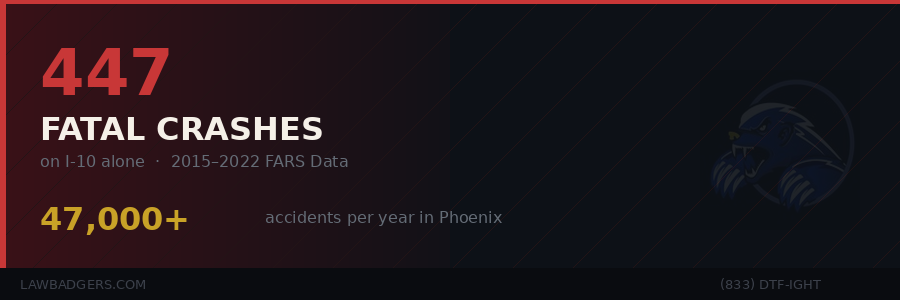
Car accidents in Phoenix are not slowing down. Our analysis of Phoenix Police Department data shows 397,481 traffic accidents from 2018 through 2026. Maricopa County leads the state with more than 4,400 fatal crashes in the last nine years.
Our analysis shows that Friday has the highest incident volume and 3:00 p.m. to 6:00 p.m. is the highest-volume time window in the Phoenix Police calls-for-service data. Those are measures of incident volume, not rankings of fatality risk. See our Arizona crash-statistics methodology and findings for the data scope. Corridors with the most fatal crashes include I-10, Indian School Road, and the West Phoenix grid between 43rd and 83rd Avenues.
If you need help understanding the claim or deadline, contact Law Badgers or call (833) DTF-IGHT. The consultation is free. No lawyer can promise a result; the facts, law, coverage, and evidence determine each case.
Sources and Legal Authorities
We link the primary rules, statutes, and public records used for the legal statements in this article.
- A.R.S. § 28-661 — Duty to Stop After an Injury or Fatal Accident — Arizona State Legislature
- A.R.S. § 28-662 — Duty to Stop After an Accident Involving Vehicle Damage — Arizona State Legislature
- A.R.S. § 28-663 — Duty to Give Information and Assistance — Arizona State Legislature
- A.R.S. § 28-666 — Immediate Notice of an Injury or Fatal Accident — Arizona State Legislature
- A.R.S. § 12-2505 — Comparative Negligence — Arizona State Legislature
- A.R.S. § 12-542 — General Two-Year Limitation — Arizona State Legislature
- A.R.S. § 12-821.01 — Notice of Claim Against a Public Entity or Employee — Arizona State Legislature
- A.R.S. § 12-821 — Actions Against a Public Entity or Employee — Arizona State Legislature
- Automobile Insurance — Accidents, Thefts, and Claims — Arizona Department of Insurance and Financial Institutions
- Contact the Phoenix Police Department — City of Phoenix
Law Badgers Legal Team
Legal information published by Law Badgers PLLC. A named attorney is shown only when that attorney's authorship or dated legal review has been confirmed.
View profile →INJURED? GET A FREE CONSULTATION.
The Law Badgers fight for maximum compensation. No fee unless we win.
Call (833) DTF-IGHT