Arizona Car Accident Statistics — Complete Crash Data 2015–2023

Arizona’s roads are becoming more dangerous every year. Between 2015 and 2023, the state recorded 8,850 fatal crashes and 9,710 traffic fatalities — a 48% increase in deadly crashes over nine years. Law Badgers built a crash data pipeline from NHTSA federal records, Phoenix Police Department incident data, and ADOT sources to produce the most comprehensive Arizona crash analysis available. This page presents that data in full.
Arizona Fatal Crash Statistics: The Complete Picture
Statewide Fatalities Are Rising Sharply
Arizona recorded 1,200 fatal crashes in 2022 and 1,198 in 2023 — the two worst years in our dataset, and roughly 48% higher than the 811 recorded in 2015. Fatalities track the same way: 1,320 people died in traffic crashes in 2022 and 1,308 in 2023, compared to 897 in 2015, a 46% increase.
| Year | Fatal Crashes | Fatalities | Change from Prior Year |
|---|---|---|---|
| 2015 | 811 | 897 | — |
| 2016 | 856 | 952 | +5.6% |
| 2017 | 917 | 998 | +7.1% |
| 2018 | 918 | 1,011 | +0.1% |
| 2019 | 908 | 979 | -1.1% |
| 2020 | 966 | 1,053 | +6.4% |
| 2021 | 1,076 | 1,192 | +11.4% |
| 2022 | 1,200 | 1,320 | +11.5% |
| 2023 | 1,198 | 1,308 | -0.2% |
The COVID-19 years are particularly telling. Despite reduced driving miles in 2020, fatal crashes increased — a pattern consistent with higher-speed driving on emptier roads. The post-COVID years locked in that elevated rate: 2022 and 2023 are effectively tied as the worst on record, and 2023 sits 24% above 2020. Arizona’s population grew roughly 13% from 2015 to 2023; fatal crashes grew several times faster.
Arizona’s Deadliest Highways
Interstate 10 Is the Most Dangerous Road in the State
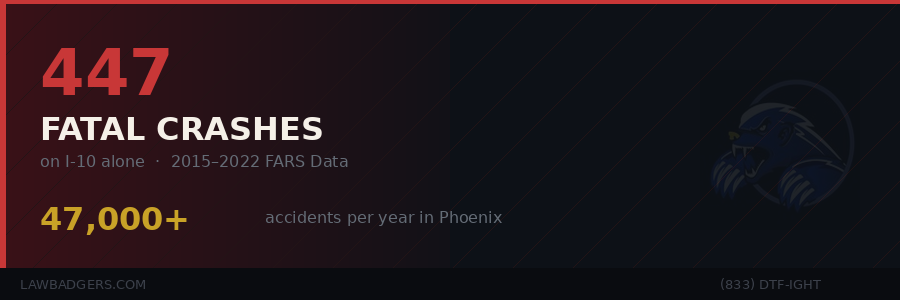
Of all roads in Arizona, Interstate 10 is the deadliest by a significant margin. NHTSA FARS data from 2015 to 2023 shows 519 fatal crashes on I-10, resulting in 618 deaths — nearly double the next most dangerous highway. One hundred and five of those crashes (20%) involved a drinking driver.
The Phoenix-to-Tucson corridor on I-10 concentrates the greatest danger. High speeds (75+ mph posted, higher in practice), heavy commercial truck traffic connecting Los Angeles ports to the rest of the country, heat-related tire blowouts, drowsy driving on long desert stretches, and Arizona’s documented wrong-way driver problem all converge on this highway.
Arizona Highway Rankings by Fatal Crashes (2015–2023)
| Rank | Highway | Fatal Crashes | Fatalities | Alcohol Involved |
|---|---|---|---|---|
| 1 | I-10 (Interstate 10) | 519 | 618 | 105 |
| 2 | US-60 (Superstition Freeway) | 283 | 313 | 67 |
| 3 | I-17 (Interstate 17) | 242 | 269 | 63 |
| 4 | I-40 (Interstate 40) | 225 | 270 | 37 |
| 5 | Loop 101 (Agua Fria/Pima/Price) | 185 | 194 | 47 |
| 6 | SR-87 (Beeline Highway) | 163 | 184 | 26 |
| 7 | Loop 202 (Red Mountain/Santan) | 105 | 116 | 28 |
| 8 | I-19 (Interstate 19) | 61 | 72 | 17 |
| 9 | SR-347 (John Wayne Pkwy) | 36 | 44 | 8 |
| 10 | Loop 303 | 26 | 30 | 11 |
| 11 | SR-51 (Piestewa Freeway) | 22 | 24 | 6 |
| 12 | SR-143 (Hohokam Expressway) | 3 | 4 | 1 |
The Valley loops appear here for the first time. FARS labels them by state-route number — SR-101 rather than “Loop 101” — and our earlier pull missed them entirely. Loop 101 is Arizona’s fifth-deadliest highway at 185 fatal crashes, ahead of SR-87 and well ahead of the other loops.
I-17 between Phoenix and Flagstaff is Arizona’s third deadliest highway, with crashes concentrated on the grades near Black Canyon City and Sunset Point and at the high-conflict merge zones approaching the I-10/I-17 Stack interchange in central Phoenix.
SR-87 (also known as the Beeline Highway, and in its southern portion Country Club Drive through Mesa and Chandler) recorded 163 fatal crashes — the sixth-most dangerous highway in the state and a significant hazard for drivers traveling between Phoenix and the White Mountains or Payson.
Arizona County-by-County Fatal Crash Data
Maricopa County Accounts for Half of All Arizona Traffic Deaths
Maricopa County recorded 4,447 fatal crashes and 4,734 deaths from 2015 to 2023 — 50.2% of all fatal crashes statewide, despite being home to roughly 60% of Arizona’s population. Fatal crashes in Maricopa rose 71% over the period, from 377 in 2015 to 646 in 2023, and 2023 was the county’s worst year on record.
| County | Fatal Crashes | Fatalities | Alcohol Involved | AZ Share |
|---|---|---|---|---|
| Maricopa | 4,447 | 4,734 | 988 | 50.2% |
| Pima | 1,187 | 1,269 | 292 | 13.4% |
| Pinal | 543 | 622 | 113 | 6.1% |
| Mohave | 445 | 513 | 88 | 5.0% |
| Yavapai | 411 | 466 | 68 | 4.6% |
| Coconino | 394 | 456 | 79 | 4.5% |
| Navajo | 307 | 375 | 63 | 3.5% |
| Apache | 249 | 289 | 56 | 2.8% |
| Yuma | 216 | 229 | 42 | 2.4% |
| Cochise | 195 | 225 | 43 | 2.2% |
| Gila | 182 | 210 | 35 | 2.1% |
| La Paz | 132 | 156 | 21 | 1.5% |
| Graham | 66 | 82 | 18 | 0.7% |
| Santa Cruz | 52 | 60 | 14 | 0.6% |
| Greenlee | 13 | 13 | 5 | 0.1% |
Pima County (Tucson) is second with 1,187 fatal crashes. Pinal County, which sits between the two metros and carries significant I-10 and US-60 traffic, recorded 543 fatal crashes — making it the third deadliest county despite a population roughly one-fifth the size of Maricopa’s.
Phoenix’s Most Dangerous Streets and Intersections
Indian School Road: Arizona’s Deadliest Surface Street
Indian School Road recorded 134 fatal crashes and 144 deaths between 2015 and 2023 — more than any other non-freeway road in Arizona. That averages about 16 traffic fatalities per year on a single street. The deadliest section runs from 19th Avenue west to 83rd Avenue, where the road functions as a high-speed arterial through dense residential and commercial development with limited pedestrian infrastructure.
The West Phoenix Grid: Arizona’s Most Dangerous Square Miles
When Phoenix’s deadliest surface streets are mapped, they converge in a corridor between 43rd and 83rd Avenues, bounded roughly by McDowell Road to the south and Bell Road to the north. The data makes the case clearly:
- Indian School Road — 134 fatal crashes (deadliest surface street in Arizona)
- Thomas Road — 119 fatal crashes
- McDowell Road — 117 fatal crashes
- Broadway Road — 109 fatal crashes
- 19th Avenue — 97 fatal crashes
- 43rd Avenue — 95 fatal crashes
- Southern Avenue — 93 fatal crashes
- 35th Avenue — 93 fatal crashes
- Camelback Road — 89 fatal crashes
- Bell Road — 85 fatal crashes
- 51st Avenue — 84 fatal crashes
Phoenix’s grid design — wide, multi-lane arterials spaced every mile, with long signal cycles and speed limits of 40–45 mph that drivers routinely exceed — creates highway-like conditions on roads that pedestrians and cyclists must cross. Pedestrian fatalities concentrate on exactly these corridors. West Phoenix’s higher rates of foot traffic combined with thinner sidewalk infrastructure make the danger worse.
Phoenix Accident Volume: Total Incidents by Road (2018–2026)
Beyond fatal crashes, Phoenix Police Department dispatch data covering 397,481 traffic incidents from 2018 to 2026 reveals the full volume picture. Indian School Road leads with 25,301 total incidents, a third of which occur during the 3–6 PM rush hour window alone:
| Road | Total Incidents | PM Rush | AM Rush | Night | Friday |
|---|---|---|---|---|---|
| Indian School Rd | 25,301 | 8,452 | 3,115 | 3,015 | 4,460 |
| Thomas Rd | 21,291 | 7,194 | 2,609 | 2,389 | 3,726 |
| McDowell Rd | 20,153 | 6,794 | 2,414 | 2,651 | 3,468 |
| 35th Ave | 17,087 | 5,458 | 2,222 | 1,984 | 2,917 |
| 19th Ave | 16,414 | 5,221 | 2,153 | 1,852 | 2,711 |
| 7th St | 16,091 | 5,807 | 2,322 | 1,475 | 2,790 |
| Camelback Rd | 15,519 | 5,252 | 1,770 | 1,715 | 2,749 |
| 43rd Ave | 14,522 | 4,737 | 1,965 | 1,912 | 2,522 |
| Bell Rd | 11,950 | 4,009 | 1,291 | 1,093 | 1,991 |
| 51st Ave | 11,690 | 3,681 | 1,576 | 1,613 | 2,018 |
The PM rush hour (3–6 PM) consistently produces the highest crash volumes across every road in the dataset — roughly twice the morning peak. Friday is the most dangerous day of the week, and now that the day-of-week field is being read for every year it is measurable: 4,460 of Indian School Road’s incidents fall on a Friday, and Friday leads citywide with 66,983 against Wednesday’s 60,999.
Explore the Data: Interactive Crash Tool
Law Badgers built this crash data explorer from the raw NHTSA FARS records and Phoenix Police incident data. Use it to examine statewide trends, compare highways and counties, search specific intersections, and view fatal crash hotspots on a live map.
Arizona Crash Data Explorer
Charts, highway rankings, county breakdowns, 100+ Phoenix intersection stats, and a fatal crash hotspot map — all interactive.
Launch the Dashboard →Phoenix’s Most Dangerous Intersections
Our analysis of 500 Phoenix intersections ranked by total incident volume identifies a clear concentration in West Phoenix. The ten highest-volume intersections all fall within the West Phoenix grid described above:
| Rank | Intersection | Total Incidents | Injury/Fatal | Injury Rate |
|---|---|---|---|---|
| 1 | S 99th Ave & W Lower Buckeye Rd | 1,161 | 107 | 9.2% |
| 2 | N 67th Ave & W Indian School Rd | 1,057 | 220 | 20.8% |
| 3 | N 51st Ave & W Indian School Rd | 984 | 178 | 18.1% |
| 4 | N 67th Ave & W McDowell Rd | 976 | 193 | 19.8% |
| 5 | N 43rd Ave & W McDowell Rd | 897 | 171 | 19.1% |
| 6 | N 43rd Ave & W Indian School Rd | 879 | 186 | 21.2% |
| 7 | N 43rd Ave & W Thomas Rd | 867 | 165 | 19.0% |
| 8 | N 51st Ave & W McDowell Rd | 844 | 174 | 20.6% |
| 9 | N 27th Ave & W Camelback Rd | 774 | 163 | 21.1% |
| 10 | N 35th Ave & W Bethany Home Rd | 760 | 135 | 17.8% |
The injury-to-total ratio at these intersections — consistently 18–21% — is the number that matters for injury claims. Close to one in five incidents at these intersections involves an injury or fatality. Note the exception: 99th Avenue and Lower Buckeye carries the highest raw volume but only a 9.2% injury rate, roughly half the rest of the list. Volume and harm are not the same thing, and the distinction matters when assessing a claim. The data is drawn from Phoenix Police Department dispatch records covering 2018 to 2026.
Why This Data Matters for Your Case
Crash data does more than satisfy curiosity. In personal injury litigation, it establishes the foreseeability of a dangerous condition — a foundational element in negligence claims.
When a client is injured at N 67th Ave and W Indian School Rd, we can show that intersection has produced 220 injury and fatal incidents — one in five of everything dispatched there. When someone is hurt on a stretch of Indian School Road, we can show the road has killed 144 people in nine years. When a crash happens on I-10, we can document that it’s the deadliest highway in Arizona with 618 fatalities from 2015 to 2023.
This data establishes that:
- The danger was known. These are not flukes. They are documented, recurring patterns visible in federal records.
- The risk was foreseeable. A reasonably careful driver — or a government entity responsible for road design — should have accounted for these conditions.
- Your injuries fit a documented pattern. Juries and adjusters respond to context. Data is context.
Law Badgers built this analysis because no other Phoenix personal injury firm has done so. We use it in every case we take involving these roads, these intersections, and these patterns.
Frequently Asked Questions About Arizona Crash Statistics
How many fatal car accidents happen in Arizona each year?
Arizona averaged 983 fatal crashes per year from 2015 to 2023. The number has risen sharply — from 811 in 2015 to 1,198 in 2023, a 48% increase. In 2022, the worst year on record, those crashes killed 1,320 people; 2023 was essentially tied at 1,308. The trend is consistently upward, with no meaningful decline after 2019.
What is the most dangerous highway in Arizona?
Interstate 10 is Arizona’s most dangerous highway by total fatal crashes. Between 2015 and 2023, I-10 recorded 519 fatal crashes and 618 fatalities — more than any other road in the state. US Route 60 (283) and Interstate 17 (242) rank second and third, with Loop 101 fifth at 185. See our full I-10 accident analysis and I-17 crash data for detailed breakdowns.
What is the most dangerous road in Phoenix?
Indian School Road is the deadliest non-freeway road in Phoenix, with 134 fatal crashes from 2015 to 2023. The highest-danger section runs from roughly 19th Avenue to 83rd Avenue. For the full analysis of Phoenix’s deadliest streets, see our West Phoenix deadly corridor report.
Which county in Arizona has the most traffic deaths?
Maricopa County (Phoenix metro) has the most traffic deaths by a substantial margin — 4,734 fatalities from 2015 to 2023, accounting for 49% of all Arizona traffic deaths. Pima County (Tucson) is a distant second at 1,269. See our Maricopa County fatal crash statistics for a year-by-year breakdown.
Are Arizona car accident fatalities increasing?
Yes, significantly. Fatal crashes increased 48% from 2015 to 2023, and fatalities rose 46% over the same period. Arizona’s population grew only about 13% during that time, meaning the per-capita fatality rate is rising sharply. 2022 and 2023 are the two worst years in the dataset, effectively tied.
When do most car accidents happen in Phoenix?
The 3–6 PM window is the highest-volume accident period across all Phoenix roads. Friday is consistently the most dangerous day. Late-night weekend hours (10 PM–2 AM) produce a secondary spike in severe crashes and fatalities, driven by impaired driving. Morning rush hour (7–9 AM) is a significant secondary volume period but produces fewer fatalities per incident than night crashes.
What should I do after a car accident on an Arizona highway?
Move to safety if possible — secondary crashes on high-speed roads are a real hazard. Call 911. Document the scene with photos and video before any vehicles are moved. Get names and contact information from all witnesses. Seek medical evaluation immediately, even if you feel uninjured — symptoms of serious injuries including traumatic brain injuries can be delayed. Call an attorney before speaking with any insurance company. See our complete Arizona car accident checklist.
Does crash data help in a personal injury lawsuit?
Yes. Crash history data establishes that a dangerous condition was known and foreseeable — both to the at-fault driver and, in some cases, to government entities responsible for road design. We use intersection-level crash data in negotiations with insurers and at trial to demonstrate that our client’s injury was not a freak accident but a predictable outcome of a documented hazard.
Data Sources and Methodology
The crash data on this page comes from three primary sources:
NHTSA Fatality Analysis Reporting System (FARS): The federal government’s official record of all fatal crashes on public roads in the United States. FARS data is collected from police crash reports, vital statistics records, and state vehicle registration files. Our dataset covers 2015–2023 for Arizona — every year NHTSA has published as a final file. We deliberately exclude NHTSA’s provisional Annual Report File for 2024, because those counts are revised in later vintages.
Phoenix Police Department Calls-for-Service Data: Dispatch records covering traffic incidents from 2018–2026, geocoded by intersection. This source captures the full incident volume — including non-fatal injury and property-damage crashes — not just fatalities. Total records: 397,481.
Law Badgers Crash Data Pipeline: We built a proprietary processing pipeline that geocodes FARS records by road and intersection, normalizes road name variants, filters by county, and aggregates by time period and road segment. The hotspot analysis uses a spatial clustering algorithm to identify grid cells with multiple fatal crashes.
Four methodology notes, each of which corrects an error in earlier versions of this page:
Alcohol involvement is now complete for all years. NHTSA removed the precomputed DRUNK_DR column from the FARS crash file after 2020, so 2021 onward previously imported as zero and every alcohol figure here understated the real number. We now derive drinking-driver counts from the vehicle-level DR_DRINK field. Validated against 2020, where both exist, this reproduces NHTSA’s official figure for all 966 Arizona cases exactly.
Road totals count every road named in a crash record. A collision at 51st Avenue and Indian School is a crash on both roads, and both now receive it. Road totals therefore overlap by design and do not sum to the statewide figure. Our earlier method assigned each crash to whichever road appeared first in a lookup list, which starved roads low in that list and inflated others.
Four years of timing data were being discarded. Phoenix writes the
call timestamp differently by year: 2018-2019 use ISO, 2025-2026 use
01/01/2025 12:01:25 AM, but 2020 and 2022-2024 use 1/1/2023 12:00:19AM –
two spaces after the date and no space before the meridiem. That variant matched
no parser, so those four years imported with no day-of-week and no hour, and
every rush-hour and day-of-week figure on this page was computed from the other
five. Indian School Road’s PM-rush count nearly doubled once the parse was
fixed, from 4,609 to 8,452.
Phoenix changed its address format mid-2025, abbreviating street suffixes (AVE became AV, BLVD became BL). Left unnormalized, every intersection split into two records and all 2025–2026 crashes dropped out of the rankings. Addresses are now canonicalized before aggregation.
Surface-street fatal crash counts are drawn from the complete FARS pull, not the geocoded subset (which is missing 188 records due to absent coordinates in the source data).
Law Badgers PLLC represents injured people in Phoenix, Maricopa County, and throughout Arizona. We handle car accidents, truck accidents, motorcycle crashes, pedestrian accidents, wrongful death, and related personal injury claims. All consultations are free. We charge no fee unless we win. Call (833) DTF-IGHT or contact us online.
Law Badgers Legal Team
Legal information published by Law Badgers PLLC. A named attorney is shown only when that attorney's authorship or dated legal review has been confirmed.
View profile →INJURED? GET A FREE CONSULTATION.
The Law Badgers fight for maximum compensation. No fee unless we win.
Call (833) DTF-IGHT