Multi-Vehicle Pileups in Arizona — Who Pays When 10 Cars Are Involved?

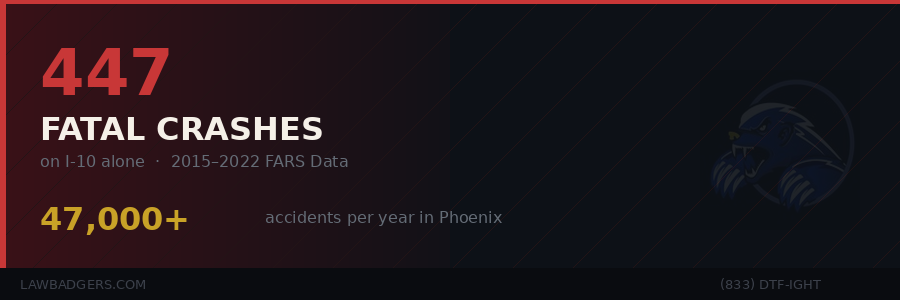
Short answer: In an Arizona multi-vehicle pileup, the driver who caused the first impact does not automatically pay for every later collision. Investigators must separate the sequence of impacts and determine whose conduct contributed to each injury or loss. More than one driver—and sometimes a commercial vehicle owner, employer, maintenance company, or public entity—may be examined, depending on the evidence.
The most useful early work is preserving the order of impacts, the vehicles’ positions, and the conditions each driver faced before tow trucks and repairs change the evidence.
How does Arizona divide fault in a chain-reaction crash?
Two Arizona statutes are central:
- A.R.S. § 12-2505 provides that a claimant’s damages may be reduced in proportion to the claimant’s fault that proximately caused the injury. The statute also contains an exception for a claimant who intentionally, willfully, or wantonly caused or contributed to the injury.
- A.R.S. § 12-2506 generally makes each defendant liable only for the damages allocated to that defendant’s percentage of fault, subject to the statute’s exceptions. The factfinder considers the fault of all people who contributed, including certain nonparties.
That means a pileup should not be treated as one undifferentiated event without analyzing each driver’s conduct and the causal sequence. A driver may have caused an initial collision, another driver may have made a later impact worse, and a claimant’s own conduct may also be disputed. Insurance adjusters can propose percentages, but a settlement position is not a court finding.
Read our fuller explanation of Arizona comparative fault.
Which evidence helps reconstruct a multi-car pileup?
The strongest reconstruction usually combines several sources rather than relying on one driver’s memory:
- Impact sequence: how many impacts each occupant felt, from which direction, and the approximate pause between them
- Final positions: lane, shoulder, direction of travel, and location of every vehicle after the collisions
- Damage patterns: the front, rear, and side damage on each vehicle
- Digital evidence: dashcam footage, nearby business or traffic video, photographs, and available vehicle data
- Independent accounts: witness contact information, 911 calls, dispatch records, and officer observations
- Road and weather conditions: visibility, standing water, debris, traffic backups, warning signs, and lighting
- Vehicle and driver records: inspection, maintenance, hours-of-service, employment, or phone evidence when relevant and lawfully obtained
A police report can organize names and observations, but it does not by itself decide civil fault. Preserve original photo and video files and do not edit them.
Map the sequence while it is still fresh
Create separate Before, Impact, and After scenes. Add every vehicle you remember, mark the direction of travel, and label any detail you are uncertain about instead of guessing.
The diagram is a memory aid and evidence-organizing tool; it is not a substitute for photographs, video, physical evidence, or professional reconstruction.
What should drivers do in an Arizona dust storm?
The Arizona Department of Transportation’s Pull Aside, Stay Alive guidance says to avoid driving into a dust storm. If dust suddenly engulfs the roadway, check surrounding traffic, slow down, and completely exit the highway if possible. ADOT advises drivers not to stop in a travel or emergency lane; once safely off the paved roadway, turn off all lights, set the parking brake, take a foot off the brake, remain buckled, and wait.
Those are safety instructions, not an automatic rule assigning legal fault. Whether a driver’s response was reasonable depends on what the driver could see, warnings received, available escape options, speed, following distance, traffic, and whether that conduct caused a particular impact.
What should you do after a pileup?
- Address safety first. Call 911 for injuries, fire, blocked high-speed lanes, or another immediate danger. Do not walk among moving vehicles to take photographs.
- Identify every collision record. Obtain the incident number and, when available, the names, vehicles, insurers, and report identifiers associated with the sequence.
- Describe impacts accurately. Record what you saw, heard, and felt. If you do not know which vehicle struck first, say that.
- Preserve the vehicle. Before repair or disposal, photograph all sides and ask whether an inspection or data preservation is appropriate.
- Seek care based on symptoms. Describe when symptoms began and follow the treating professional’s instructions.
- Notify your insurer promptly. Ask which coverages are being reviewed. Depending on the policy and facts, collision, medical-payments, uninsured-motorist, or underinsured-motorist coverage may matter.
Early legal review can be especially useful when vehicles disappear into different tow yards, commercial records may be overwritten, several insurers dispute the impact sequence, or injuries exceed a driver’s available coverage.
If you want Law Badgers to review an Arizona pileup, contact us or call (833) DTF-IGHT. A consultation is free, and no lawyer can promise a particular allocation of fault or result.
Tell us what happened
Answer a few quick questions so the right person can review your situation. You can stop at any time.
- Sent privately
- No-cost review
- No obligation
Your request was received
A Law Badgers team member will review it and follow up. If you need immediate help, you can call now.
Call (833) DTF-IGHTSources and Legal Authorities
We link the primary rules, statutes, and public records used for the legal statements in this article.
- A.R.S. § 12-2505 — Comparative Negligence — Arizona State Legislature
- A.R.S. § 12-2506 — Apportionment of Fault and Several Liability — Arizona State Legislature
- Pull Aside, Stay Alive — Dust Storm Safety — Arizona Department of Transportation
Law Badgers Legal Team
Legal information published by Law Badgers PLLC. A named attorney is shown only when that attorney's authorship or dated legal review has been confirmed.
View profile →INJURED? GET A FREE CONSULTATION.
The Law Badgers fight for maximum compensation. No fee unless we win.
Call (833) DTF-IGHT