I-10 Accidents in Arizona — The Deadliest Highway in the State

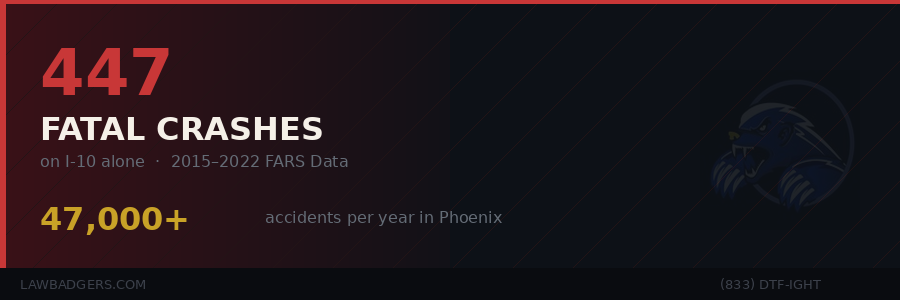
Interstate 10 is the deadliest highway in Arizona. Our analysis of the National Highway Traffic Safety Administration’s Fatality Analysis Reporting System (FARS) reveals 519 fatal crashes on I-10 between 2015 and 2023 — more than any other road in the state. That’s roughly one fatal crash every week across nine years of data.
I-10 by the Numbers
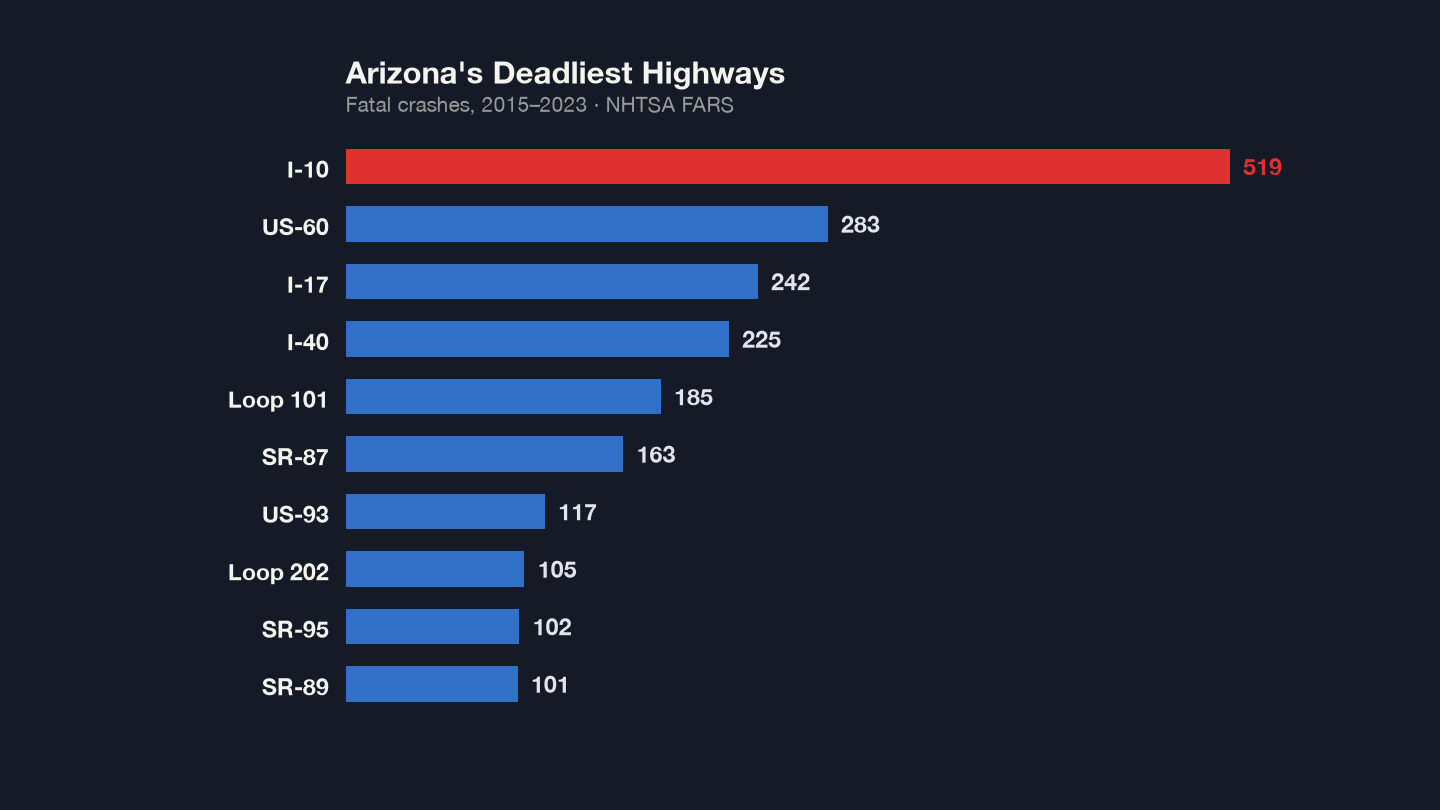
Here’s how I-10 compares to other Arizona highways:
- I-10: 519 fatal crashes — the deadliest by a wide margin
- US-60: 283 fatal crashes
- I-17: 242 fatal crashes
- I-40: 225 fatal crashes
- Loop 101: 185 fatal crashes
- SR-87: 163 fatal crashes
I-10 carries nearly twice as many fatal crashes as the next most dangerous road. And these are just the fatalities — the total number of injury and property-damage crashes is many times higher.
Why I-10 Is So Dangerous
Several factors converge to make I-10 uniquely dangerous in Arizona.
Speed and distance. I-10 runs 392 miles across Arizona — from the California border through Phoenix to Tucson and on to New Mexico. Much of it is long, straight desert highway where speeds of 75+ mph are common. At those speeds, any error — a tire blowout, a moment of inattention, a lane drift — becomes lethal.
Truck traffic. I-10 is a major commercial freight corridor connecting the ports of Los Angeles and Long Beach to the rest of the country. Heavy truck traffic means more encounters between passenger vehicles and large commercial vehicles. The mechanism matters: an unsecured load or cargo spill raises different evidence questions than a jackknife crash. Our Arizona truck-accident guide explains the broader claim process.
Fatigue. Long desert stretches can make drowsiness especially dangerous. Commercial property-carrying drivers are generally subject to federal driving-time, duty-window, break, and weekly limits, with exceptions that depend on the operation. Our guide to truck-driver fatigue and hours-of-service evidence explains what the rules say and which records may show whether they were followed.
Heat. Arizona’s extreme summer temperatures punish both vehicles and drivers. Tire blowouts increase dramatically when road surface temperatures exceed 150°F. Overheating engines and blown radiators cause disabled vehicles on the shoulder — creating hazards for passing traffic. And heat stroke affects drivers’ judgment and reaction times.
Wrong-way drivers. Arizona has a well-documented wrong-way driver problem, and I-10 is one of the highways most affected. Wrong-way crashes are almost always head-on collisions at combined speeds of 130+ mph. They are among the most likely to be fatal.
The I-10/I-17 Stack Interchange
The interchange where I-10 and I-17 merge in central Phoenix — known as “The Stack” — is one of the most dangerous stretches of highway in the state. The complex weaving patterns, high traffic volumes, and short merge distances create a constant stream of sideswipe collisions, rear-end crashes, and multi-vehicle pileups. If you commute through The Stack, you already know.
When Fatal Crashes Happen on I-10
Our data shows that I-10 fatal crashes peak during late-night and early-morning hours (10 PM – 4 AM) when drowsy and impaired driving are most common, Friday and Saturday nights when DUI rates spike, holiday weekends — especially Memorial Day, Fourth of July, and Labor Day, and monsoon season when sudden storms reduce visibility and flood low-lying sections.
What to Do If You’re in an I-10 Crash
I-10 crashes can present unique challenges. High speeds may contribute to more severe injuries. Remote stretches between cities can mean longer emergency response times. When a commercial truck is involved, the investigation may include additional companies, records, and federal rules; our comparison of truck and car accident claims explains those differences.
If you’re in an I-10 crash, move to safety if possible — the shoulder of a high-speed highway is an extremely dangerous place to stand. Call 911. Document everything you can. And contact the Law Badgers as soon as possible.
We handle I-10 accident cases across the full length of the highway — from Buckeye to Casa Grande to Tucson and beyond. Our crash data analysis gives us insights into I-10 accident patterns that most firms simply don’t have.
Arizona’s Deadliest Roads — The Full Picture
I-10 leads, but the danger extends across Arizona’s highway system. Here are the top 10 deadliest roads from our FARS analysis (2015–2023):
- I-10 — 519 fatal crashes
- US-60 — 283 fatal crashes
- I-17 — 242 fatal crashes
- I-40 — 225 fatal crashes
- Loop 101 — 185 fatal crashes
- SR-87 — 163 fatal crashes
- US-93 — 117 fatal crashes
- Loop 202 — 105 fatal crashes
- SR-95 — 102 fatal crashes
- SR-89 — 101 fatal crashes
If you or a loved one has been injured on any of these roads — or on any road in Arizona — the Law Badgers are here to fight for your recovery.
Sources and Legal Authorities
We link the primary rules, statutes, and public records used for the legal statements in this article.
- Fatality Analysis Reporting System (FARS) — National Highway Traffic Safety Administration
- Summary of Hours of Service Regulations — Federal Motor Carrier Safety Administration
Law Badgers Legal Team
Legal information published by Law Badgers PLLC. A named attorney is shown only when that attorney's authorship or dated legal review has been confirmed.
View profile →INJURED? GET A FREE CONSULTATION.
The Law Badgers fight for maximum compensation. No fee unless we win.
Call (833) DTF-IGHT