Car Accidents During Phoenix Rush Hour — What 397,481 Crash Records Reveal

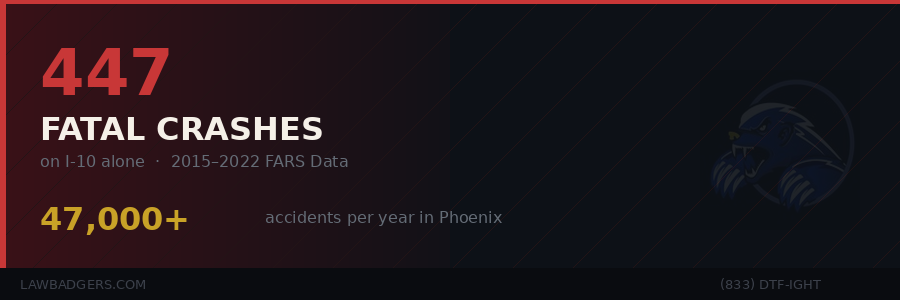
If you’ve been in a car accident during Phoenix rush hour, you’re not alone — and the data proves it.
Law Badgers analyzed 397,481 police-dispatched traffic accident calls in Phoenix between 2018 and 2026. The pattern is unmistakable.
The Most Dangerous Window: Friday, 3-6 PM
Our data shows that the single highest-volume window for traffic accidents in the Phoenix metro is Friday between 3:00 PM and 6:00 PM. This three-hour window consistently produces more accidents than any other period.
The reasons compound on each other. Traffic volume peaks as commuters, weekend travelers, and commercial vehicles all share the road simultaneously. Driver fatigue is at its highest after a full work week. Distraction increases — people are checking their phones, adjusting GPS for weekend plans, and mentally disengaging from work. And the afternoon sun can create severe glare on east-west corridors, temporarily blinding drivers at the worst possible moment.
The Roads That Light Up
When we map rush hour accidents by location, the same corridors appear repeatedly.
The I-10 corridor — particularly between the I-17 Stack and Chandler Boulevard — sees the heaviest rush hour crash volume. This stretch handles commuter traffic from the entire East Valley funneling into central Phoenix.
Loop 101 between Scottsdale Road and the I-17 interchange is another rush hour hotspot, with merge conflicts and speed differentials creating chain-reaction collisions.
Surface streets aren’t immune. Indian School Road, Thomas Road, Camelback Road, and McDowell Road — the major east-west arterials — see concentrated rush hour accidents at signalized intersections where red-light running and left-turn conflicts are most common.
Rush Hour Crashes Are Different
Rush hour accidents have characteristics that affect your legal case.
Multiple vehicles. Stop-and-go traffic creates chain-reaction rear-end collisions involving three, four, or more vehicles. Determining liability in a multi-vehicle pileup is more complex than a standard two-car crash.
More witnesses. The heavy traffic that causes the crash also means there are more potential witnesses. But witnesses leave quickly — if the police don’t get their information at the scene, they may be gone.
Camera coverage. Major freeways and intersections have ADOT traffic cameras and nearby business surveillance. This footage can be critical evidence, but it’s often overwritten within days.
Delayed injuries. Rear-end collisions in slow-moving traffic can seem minor at the time — but they’re the primary cause of whiplash injuries and delayed back pain that worsen over days or weeks.
What to Do After a Rush Hour Crash
Move to safety. In heavy traffic, secondary crashes are a real danger. Move your vehicle to the shoulder if possible. Turn on hazard lights.
Call 911. Even if the damage seems minor, get a police report. Rush hour multi-vehicle incidents are liability disputes waiting to happen, and the police report documents positions, statements, and conditions at the scene.
Get witness information. Ask anyone who stopped if they saw what happened. Get names and phone numbers before traffic clears and they drive away.
Photograph everything. Before vehicles are moved, photograph the positions of all vehicles, damage, traffic signals, road conditions, and the general traffic environment.
See a doctor the same day. Even if you feel fine. The adrenaline from the crash and the stress of dealing with rush hour traffic can mask symptoms. Go to the ER or urgent care and tell them you were in an accident.
Your Commute Is More Dangerous Than You Think
Check your personal risk with our Commute Danger Score — enter the roads you drive daily and see a danger rating based on real crash data. Or plot your route on the Route Danger Map and see every fatal crash site along your daily drive.
If you’ve been injured in a rush hour crash, call (833) DTF-IGHT for a free consultation.
Law Badgers Legal Team
Legal information published by Law Badgers PLLC. A named attorney is shown only when that attorney's authorship or dated legal review has been confirmed.
View profile →INJURED? GET A FREE CONSULTATION.
The Law Badgers fight for maximum compensation. No fee unless we win.
Call (833) DTF-IGHT